
Speaker diarization partitions an audio recording into speaker-homogeneous segments to answer one question: who spoke when. It underpins meeting transcription, broadcast indexing, and call-centre analytics, and it operates as a distinct process from transcription itself. This article covers the main system architectures, the pipeline components that determine accuracy, how diarization is benchmarked, and what practical trade-offs matter when you deploy it.
TL;DR:
- Using a known, fixed number of speakers improves diarization accuracy in systems with a modular pipeline.
- Improving voice activity detection and boundary timing directly reduces missed speech errors more than upgrading embeddings.
- Cross-dataset evaluation remains essential, as benchmark results on structured meeting data do not reliably predict performance in noisy or multi-language scenarios.
- Incorporating spatial cues from multiple microphones helps resolve overlapping speech and enhances accuracy in specific settings, but adds engineering complexity.
- On-device processing protects privacy and simplifies integration for meeting minutes, especially when handling confidential or sensitive audio content.
Table of Contents
- What is speaker diarization, and how does it differ from transcription?
- Which system architecture should you use: modular, end-to-end, or hybrid?
- How does a speaker diarization pipeline actually process audio?
- How is diarization accuracy measured, and where does it fail?
- How do you run speaker diarization in Python, and what should you consider for deployment?
- Which datasets and benchmarks does diarization research actually rely on?
- What recent advances are pushing diarization beyond EEND?
- Can multiple microphones improve diarization accuracy?
- Why is overlapping and noisy speech still the hardest diarization problem?
- What post-processing techniques improve raw diarization output?
- Publisher perspective: why on-device diarization matters for meetings
- Try speaker diarization built for meetings, not research benchmarks
- Sources
What is speaker diarization, and how does it differ from transcription?
Diarization and automatic speech recognition (ASR) solve different problems. ASR converts speech to text; diarization assigns speaker identity to time regions, independent of what was said. Speaker identification and verification are related but narrower tasks: they match a voice against a known enrolled identity, whereas diarization typically operates without any prior knowledge of who is present.
A few terms recur throughout diarization research and are worth fixing early:
- Segment: a contiguous stretch of audio attributed to one speaker.
- Turn: a speaker's continuous speaking interval, which may span several segments once silences are removed.
- Embedding: a fixed-length vector representation of a speaker's vocal characteristics, used for comparison and clustering.
- Cluster: a group of segments the system believes belong to the same speaker.
- Exclusive diarization: output that assigns exactly one speaker to each timestamp region, which simplifies reconciliation with transcript timestamps.
Diarization sits upstream or alongside ASR in most production pipelines. Without it, a transcript is a wall of undifferentiated text; with it, you get structured, attributable dialogue.
Which system architecture should you use: modular, end-to-end, or hybrid?
Three broad paradigms dominate current diarization research, and each makes a different trade-off between flexibility and complexity.
Modular (cascaded) pipelines run voice activity detection, segmentation, embedding extraction, and clustering as separate stages. This lets you swap or tune individual components independently, which is useful when your domain has unusual acoustic conditions. The drawback is error propagation: a mistake in voice activity detection carries through every downstream stage, and there's no mechanism to correct it later.
End-to-end neural diarization (EEND) models replace the cascade with a single network trained to output speaker labels directly, often handling overlapping speech more naturally than clustering-based systems. Training is comparatively simpler because it optimises one objective rather than several disconnected ones. The constraint is that many EEND variants struggle with variable or high speaker counts and with long recordings, since the model architecture often assumes a bounded number of speakers.
Hybrid designs attempt to get the best of both: they apply EEND-style processing within short chunks, then use global clustering across chunks to stitch speaker identities together across a full recording. This balances the overlap-handling strength of end-to-end models with the scalability of clustering. Current architectural comparisons from NVIDIA's NeMo framework treat this hybrid approach as the practical middle ground for production systems handling variable-length meetings.
- Modular: flexible, debuggable, but error-prone across stages.
- EEND: strong on overlap, weak on speaker-count and duration scaling.
- Hybrid: chunked EEND plus clustering for longer, variable-speaker audio.
Pro Tip: If your audio has a known, bounded number of speakers (a two-person interview, a four-person panel), a modular pipeline with the speaker count supplied is usually more reliable than an automatic EEND system guessing that count from the acoustic signal alone.
How does a speaker diarization pipeline actually process audio?
A standard modular pipeline runs voice activity detection, segmentation, speaker embedding extraction, and clustering in sequence, with agglomerative hierarchical clustering commonly used as the bottom-up grouping method. Each stage has practical failure points worth understanding before you tune anything.
- Voice activity detection (VAD): this decides which frames contain speech at all. A threshold set too aggressively drops quiet speech onsets and offsets, which directly inflates missed-speech error. A threshold set too loosely lets background noise register as speech, inflating false alarms. Test both directions against your specific recording environment rather than trusting a default.
- Segmentation and change-point detection: this splits continuous audio into speaker-homogeneous chunks. Setting a minimum segment length prevents the model from fragmenting a single utterance into unstable micro-segments, and applying a small collar (a forgiveness window around boundaries, often a few hundred milliseconds) avoids penalising near-miss timing during evaluation.
- Embedding extraction: each segment is converted into a vector capturing vocal identity. Embedding quality degrades under background noise, reverberation, and short segment duration, so segments under roughly one second often produce unreliable vectors regardless of model quality.
- Clustering: segments are grouped by embedding similarity. Supplying a known speaker count when available (a fixed meeting roster, for instance) generally outperforms automatic speaker-count estimation, which struggles most in high-speaker or highly dynamic settings.
- Overlap reconciliation: overlapping speech has to be resolved against ASR timestamps, either through exclusive diarization output or a dedicated post-processing reconciliation step.
How is diarization accuracy measured, and where does it fail?
Diarization Error Rate (DER) is the standard evaluation metric, and it breaks into three components: missed speech (speaker time the system failed to detect at all), false alarm (non-speech or noise wrongly labelled as speech), and speaker confusion (speech correctly detected but assigned to the wrong speaker).
Across benchmarks evaluating multiple state-of-the-art systems across languages and recording conditions, missed-speech detection consistently emerges as the dominant error mode, ahead of speaker confusion, for meeting-style and conversational audio.
That finding has a direct practical implication: if you're debugging a diarization system with a disappointing DER, check timing and boundary precision before you swap embedding models. Teams often jump straight to a "better" speaker embedding when the actual leak is a VAD threshold missing quiet speech at turn boundaries.
Cross-dataset evaluation also reveals real variability. Systems tuned on English broadcast data don't automatically transfer to multi-party meetings or low-resource languages, and dataset scarcity in under-represented languages measurably reduces performance. Model performance also tends to degrade as true speaker count rises, particularly for architectures that estimate speaker count automatically rather than accepting it as an input. High-speaker-count, drama-style, or heavily overlapping audio remains one of the harder conditions across current benchmarks, and EEND variants built for overlap modelling are a promising but not yet fully mature answer to it.
How do you run speaker diarization in Python, and what should you consider for deployment?
A practical experimental workflow looks like this: resample and normalise your audio to a consistent sample rate, optionally apply source separation if your recordings have heavy cross-talk, run your chosen diarization pipeline, then export speaker-labelled timestamps and reconcile them against your ASR transcript output.
Preprocessing decisions deserve more care than they usually get. Source separation (isolating vocal stems from background noise or music) can meaningfully improve clustering-based embeddings by removing interference, but it can just as easily harm performance in models that were trained on raw, unprocessed audio, since the separation artefacts introduce a distribution the model has never seen. Practical guidance on this trade-off recommends validating preprocessing choices on a held-out sample from your actual deployment domain rather than assuming a technique that helped elsewhere will help you.
- Resample and normalise before anything else, so downstream components see consistent input.
- Supply a known speaker count wherever your use case allows it.
- Validate source separation on your own audio before adopting it as a default step.
- Reconcile diarization timestamps against ASR output using either exclusive diarization or a collar-based post-processing step.
Pro Tip: On-device deployment removes network latency entirely and keeps raw audio off any server, which matters more than most published benchmarks suggest once you're handling confidential meeting content rather than public broadcast data.
Deployment splits into two broad paths. Cloud-based diarization scales well for batch processing of large archives, but introduces network latency and, depending on jurisdiction, data-handling considerations. On-device or local processing avoids both, at the cost of being bound by whatever compute the local hardware provides, which shapes how large a model you can realistically run in real time.
Which datasets and benchmarks does diarization research actually rely on?
Reproducible evaluation depends on shared datasets, and a handful of resources recur across nearly every published benchmark. The AMI Meeting Corpus, recorded across multi-party meeting scenarios with close-talking and array microphones, remains a standard reference for meeting-style diarization because it captures natural overlap, cross-talk, and variable speaker counts under realistic conditions.
VoxConverse extends evaluation into broadcast and "in the wild" audio, drawing from television and online video, which stresses systems against background noise, music, and unpredictable speaker turnover rather than the relatively controlled acoustics of a meeting room. This matters because a model that performs well on AMI doesn't automatically transfer to noisier, less structured recordings.
LDC (Linguistic Data Consortium) corpora and NIST resources round out the benchmarking landscape. NIST's Rich Transcription (RT) evaluation series has functioned for years as a standard testbed for speech and diarization system comparison, giving researchers a consistent protocol rather than each lab inventing its own scoring method.
The practical lesson for anyone deploying diarization commercially: benchmark numbers reported on any single dataset don't generalise cleanly. A system's DER on AMI tells you how it handles structured meetings, not how it will handle a noisy call-centre recording or a broadcast clip with background music. Cross-dataset evaluation, testing the same model across at least two structurally different corpora, is the only reliable way to estimate how a diarization system will behave on audio it hasn't seen before. Language coverage compounds this: most public benchmark data skews toward English and a small set of other major languages, so performance claims rarely transfer cleanly to lower-resource languages without dedicated evaluation.
What recent advances are pushing diarization beyond EEND?
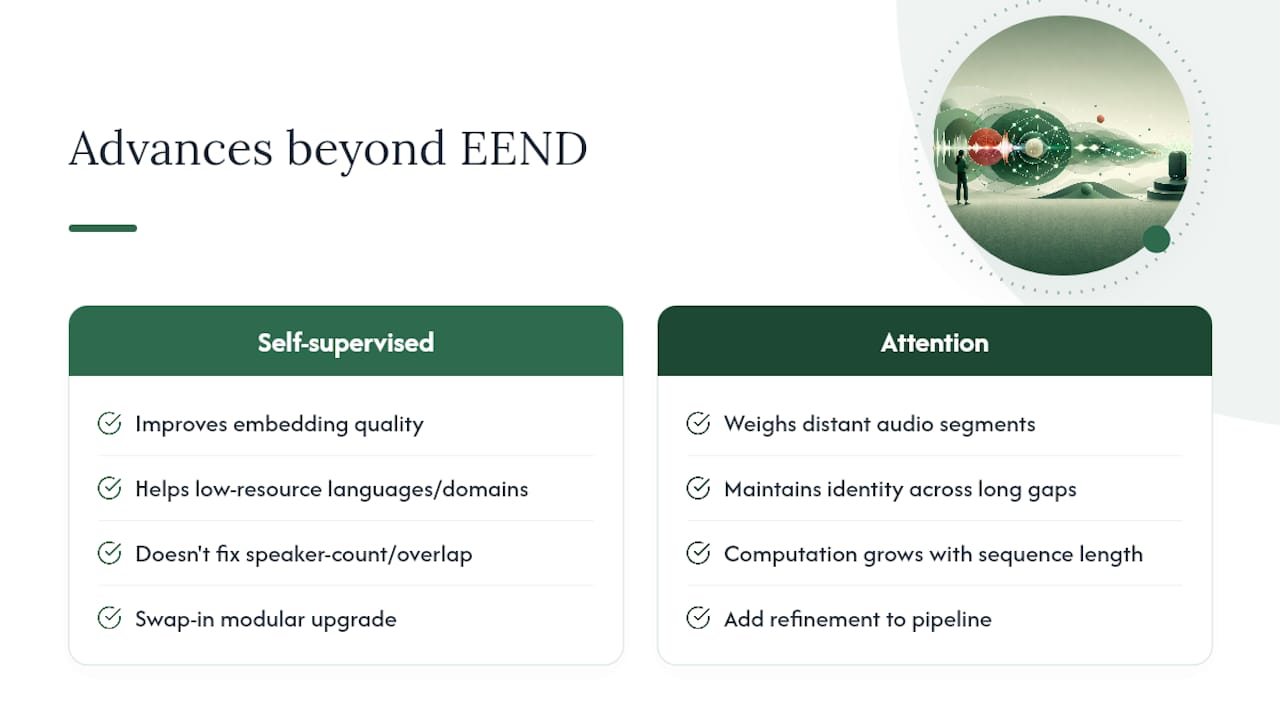
The field has moved past treating end-to-end neural diarization as the final architectural answer. Self-supervised learning, where models learn speaker representations from large volumes of unlabelled audio before any diarization-specific fine-tuning, has improved embedding quality in settings where labelled diarization data is scarce. This matters most for languages and domains without abundant annotated meeting or broadcast corpora, since the self-supervised pretraining stage doesn't require speaker labels at all.
Attention mechanisms, borrowed from the broader transformer architecture family, have been integrated into diarization models to let the network weigh relationships between distant segments of audio rather than processing strictly local context. This helps with a specific weakness of earlier sequential models: maintaining consistent speaker identity across long gaps, such as when a participant stays silent for several minutes before speaking again.
Neither development eliminates the core constraints identified earlier. Self-supervised pretraining improves the quality of the embeddings a system starts with, but it doesn't solve speaker-count estimation or overlap resolution on its own. Attention-based architectures still face the same duration and speaker-count scaling questions that constrain other EEND variants, since attention computation cost typically grows with sequence length.
What's changed practically is the modularity of improvement. Rather than retraining an entire diarization system from scratch, teams increasingly swap in a better self-supervised embedding backbone or add attention-based refinement to an existing clustering pipeline. That incremental path, improving one component without discarding the whole architecture, is arguably more useful to practitioners than any single new end-to-end model, because it lets you upgrade without re-validating an entire production pipeline against your benchmark data.
Can multiple microphones improve diarization accuracy?
Multi-microphone and cross-channel diarization exploits spatial information that a single-channel recording simply doesn't contain. When a meeting room has an array of microphones, or when each participant has a dedicated lapel microphone feeding a separate channel, the system can use differences in arrival time and signal strength across channels to help separate speakers, on top of whatever it learns from vocal characteristics alone.
This spatial information is particularly valuable for resolving overlapping speech. Two speakers talking simultaneously might produce nearly indistinguishable embeddings from a single mixed-down channel, but if each has a dominant signal on a different microphone, the spatial cue disambiguates what the acoustic embedding alone cannot.
Cross-channel approaches introduce their own engineering overhead. Channels need tight time synchronisation, since even small clock drift between microphones corrupts the spatial cues the system relies on. Array geometry (how far apart the microphones sit, and in what configuration) affects how much spatial resolution is actually available, and a system tuned for one room's array won't necessarily generalise to a different physical layout without recalibration.
For most meeting-transcription use cases, a single good-quality microphone captured close to the speakers, combined with a well-tuned single-channel diarization pipeline, delivers most of the practical benefit at a fraction of the deployment complexity. Multi-microphone setups earn their overhead in specific scenarios: large conference rooms with fixed installed hardware, courtroom or hearing recordings with assigned microphone positions, or research settings where the marginal accuracy gain justifies the calibration cost.
Why is overlapping and noisy speech still the hardest diarization problem?
Overlapping speech, where two or more people talk simultaneously, remains one of the most persistent sources of error across diarization architectures. Clustering-based modular pipelines have no native mechanism for assigning a single audio frame to two speakers at once, which means overlapping regions routinely get attributed to whichever speaker's embedding happens to dominate the mixed signal, silently dropping the other speaker's contribution.
EEND-style models handle overlap more gracefully by design, since their output format can natively support multiple active speaker labels per frame. That said, current benchmarks note this overlap-handling strength comes with speaker-count and duration limitations that constrain how well it scales to longer, more populous recordings.
Background noise compounds the overlap problem rather than acting as a separate issue. Noisy environments degrade the embeddings a clustering system depends on, and they make voice activity detection less reliable at exactly the moments when speech onset and offset boundaries matter most. A noisy recording with frequent overlap, a busy call-centre floor, for instance, tends to stack these two failure modes on top of each other rather than presenting them in isolation.
Practical mitigation tends to focus on the recording setup rather than the model alone: closer microphone placement, physical separation between speakers where feasible, and, where the architecture supports it, explicit overlap-aware training data during fine-tuning. No current architecture eliminates the overlap problem outright; the realistic goal is minimising how often it occurs and limiting how much it degrades the surrounding, non-overlapping segments once it does.
What post-processing techniques improve raw diarization output?
Raw diarization output rarely leaves a pipeline ready for direct use. Post-processing closes the gap between what a model predicts and what a usable transcript needs.
Collar-based smoothing trims spurious short segments at boundaries, where a model briefly flickers between two speaker labels around a genuine turn boundary. Minimum-duration filtering removes segments too short to represent a real speaker turn, typically fragments under a few hundred milliseconds that are more likely noise or model uncertainty than an actual short utterance.
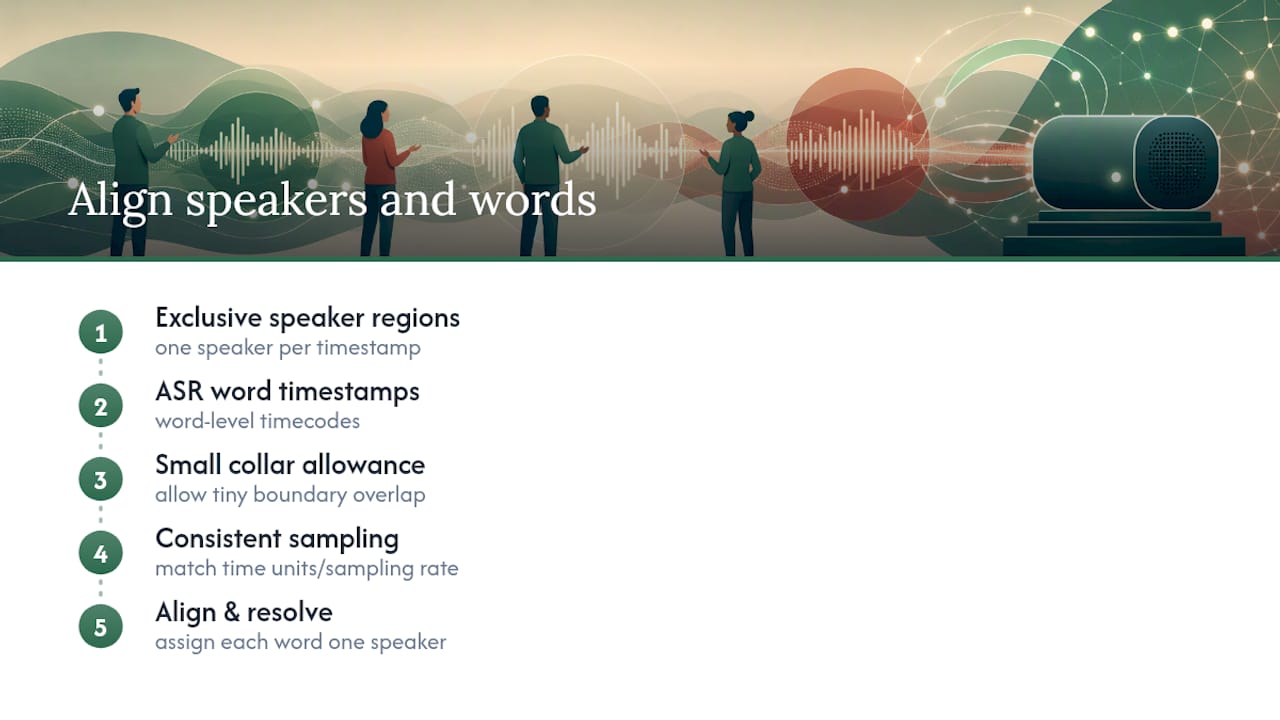
Exclusive diarization output, where each timestamp region is assigned to exactly one speaker, simplifies one of the trickiest post-processing steps: reconciling diarization timestamps with ASR word-level timestamps. Without an exclusive format, aligning "who spoke this word" against "what word was spoken" requires an additional resolution step, typically a small collar allowance and a consistent sampling rate between both systems' outputs, to handle cases where the two timestamp sets don't line up exactly.
Speaker-count consolidation catches a specific model failure: fragmenting one real speaker into two or more clusters because their voice varied slightly across the recording (background noise, distance from the microphone, or vocal fatigue over a long meeting). Merging clusters that share highly similar embeddings, applied cautiously, recovers accuracy that the raw clustering stage missed. None of these techniques fix a fundamentally weak embedding model, but applied together, they typically close a meaningful portion of the gap between raw model output and a transcript a human would consider accurate.
Publisher perspective: why on-device diarization matters for meetings
Minuted approaches diarization from a specific angle: meeting minutes, not research benchmarks. On-device processing and speaker labelling map directly onto that job, turning a raw recording into attributed, structured minutes without audio leaving the device. That distinction, labelling who said what rather than just transcribing what was said, is what separates a usable action-item log from a wall of undifferentiated text.
The practical integration points worth building around are calendar sync (so minutes attach to the right meeting automatically), action-item extraction from labelled speaker turns, and preserving privacy by design rather than as an afterthought. For any organisation handling confidential discussions, that architectural choice, processing on-device rather than routing audio through a cloud pipeline, deserves more weight than it typically gets in feature comparisons.
— James
Try speaker diarization built for meetings, not research benchmarks
Minuted applies on-device diarization directly to meeting minutes: audio is transcribed and speakers are labelled without ever leaving your device, and it keeps working without an internet connection.
That matters beyond privacy. Every trade-off covered above, missed speech at turn boundaries, overlap between colleagues talking over each other, speaker-count handling in a five-person call, is exactly what determines whether your meeting minutes are usable or not. Minuted's speaker labelling and integration features sync with Google and Outlook calendars and hand off action items to Todoist, monday.com, or Notion, so labelled transcripts become structured minutes rather than a raw text dump you still have to process by hand.
If privacy is the deciding factor for your organisation, Minuted's own comparison of what data leaves the device versus other notetaking tools is worth reading before you commit to any pipeline.
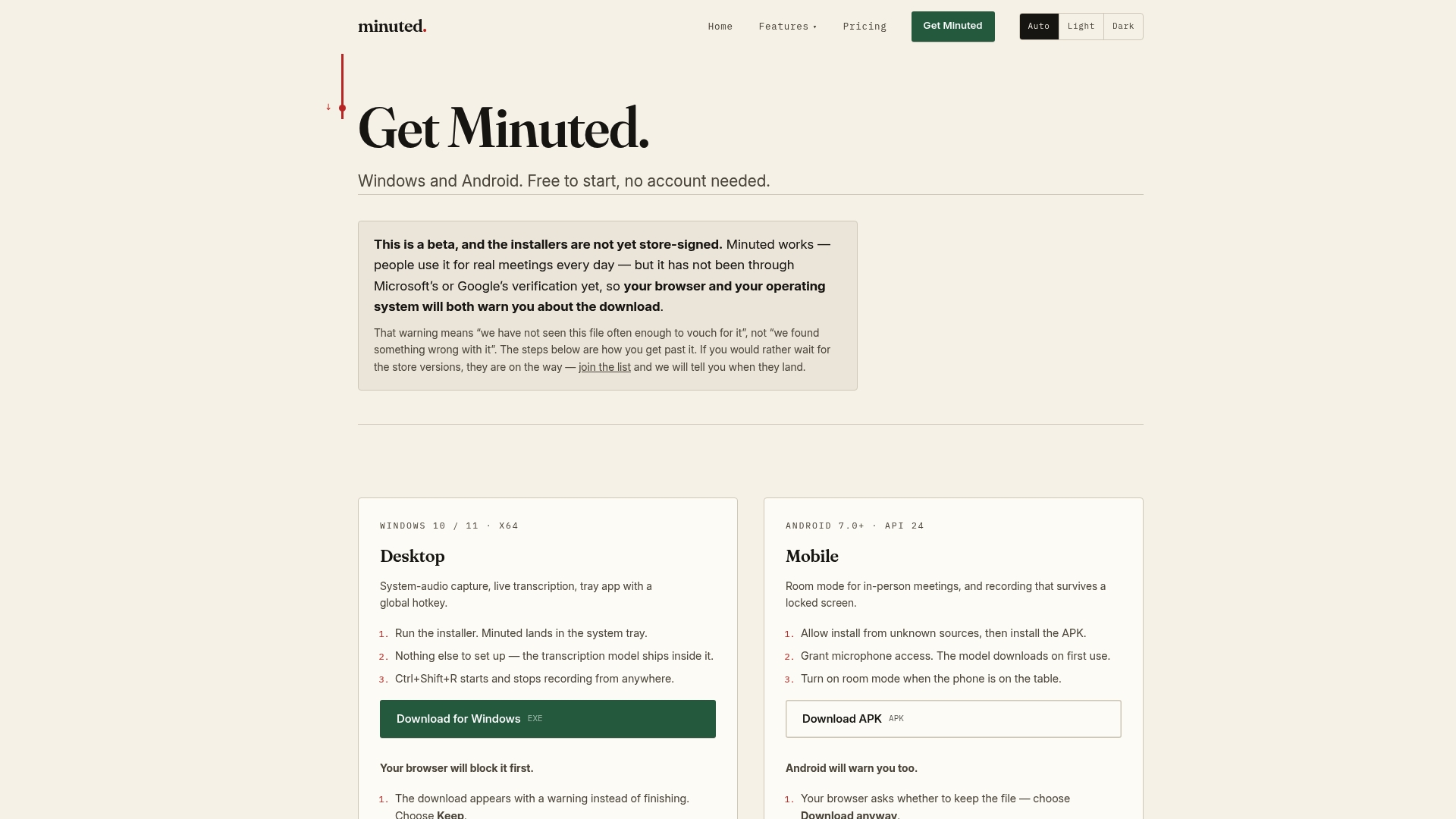
Test it against your own recordings: run a real meeting through Minuted's free local mode and check how it handles your specific speaker count, your typical cross-talk, and your room acoustics. Download Minuted and see how it performs on the audio you actually work with.
Sources
- Benchmarking diarization models — arXiv (2025)
- Speaker Diarization — Aalto University Wiki
- NIST RT tests — ITL/NIST