
Good project kickoff minutes capture decisions, action owners with dates, scope boundaries, key risks and an escalation path, and they must reach every stakeholder within 24 hours. Anything less turns the kickoff meeting into a talking shop with no record of what was agreed. This guide gives you the templates, capture tactics, and follow-up sequence to make that happen every time.
TL;DR:
- Clear escalation paths with specific thresholds help prevent local delays from turning into weeks-long project setbacks.
- Tailored templates for internal teams, clients, and executives ensure that minutes are concise, relevant, and aligned with each stakeholder's focus.
- Assigning a dedicated note-taker, using transcription tools, and pre-filling templates during meetings improve accuracy and speed of documentation.
- Distributing minutes within 24 hours and immediately transferring actions to project management tools keeps everyone aligned and accountable.
- Recording and transcribing the kickoff allows immediate capture of decisions and action items, especially valuable in fast-paced or complex meetings.
Table of Contents
- What should project kickoff minutes include?
- Which kickoff minutes template should you use?
- How do you capture accurate minutes during the kickoff?
- How fast should you distribute kickoff minutes?
- Kickoff minutes readiness and distribution checklist
- When does transcription actually help with kickoff minutes?
- What actually prevents kickoff failures
- Turn kickoff minutes into tracked work automatically
- Sources
- FAQ
What should project kickoff minutes include?
Kickoff minutes only earn their place in the project file if they capture the right fields, consistently, every time. Skip one and you create a gap that surfaces weeks later as a dispute over "what we actually agreed."
Start with basic meeting identification: project name, date, facilitator, note-taker, and a list of attendees and notable absentees. This sounds administrative, but it matters later when someone asks who was in the room for a particular call.
From there, the substance:
- Decisions: what was decided, who made the call, and the date it was made
- Action items: an owner, a due date, and acceptance criteria for anything non-obvious
- Scope boundaries: explicit in-scope and out-of-scope items, stated as plainly as the in-scope ones
- Success criteria: the measurable outcomes the project will be judged against
- Timeline and milestones: dates and the dependencies that sit behind them
- RAID entries: risks, assumptions, issues and dependencies, each with an owner and a severity rating
- Communication plan and escalation path: named individuals and the thresholds that trigger escalation
That last point gets skipped more than any other. A named escalation path with clear thresholds stops a two-day slip from quietly becoming a two-week one, because everyone already knows who to call and at what point. Scope boundaries deserve the same explicit treatment. Writing down what is not included is often more useful than writing down what is, since ambiguity about scope is where most disputes start.
Which kickoff minutes template should you use?
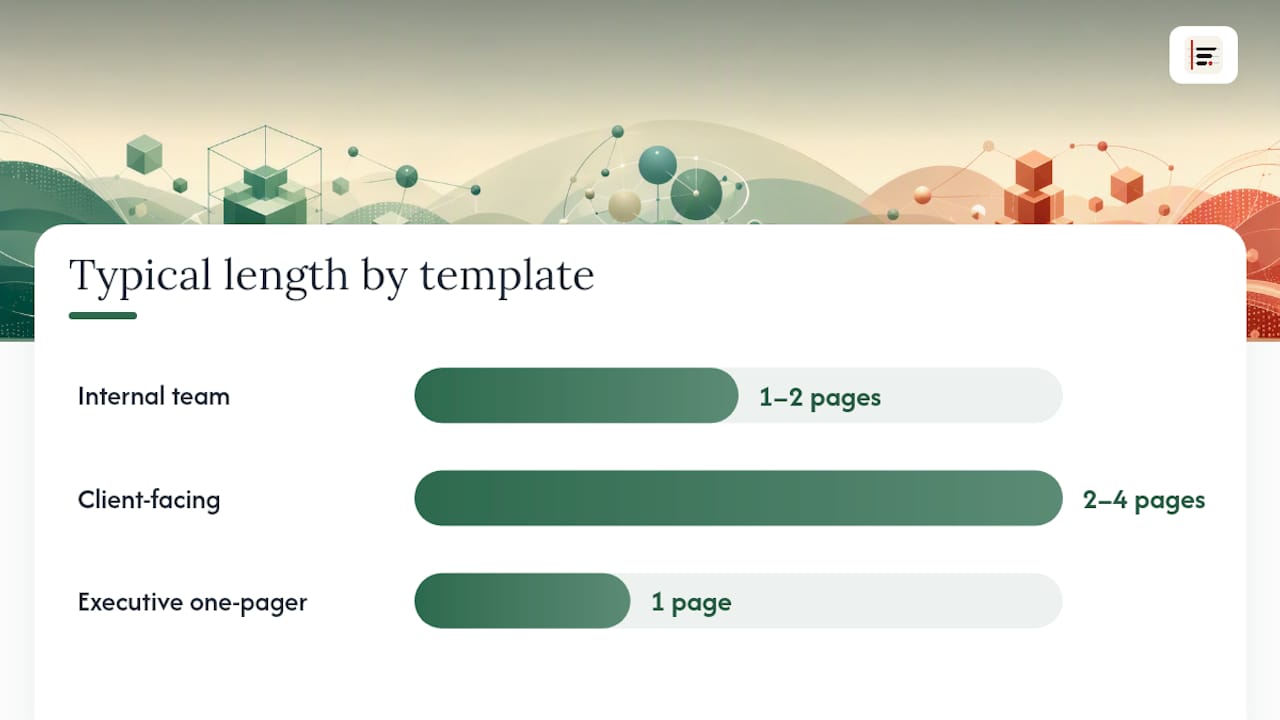
Not every audience needs the same document. Sending a client the same action-heavy notes you'd give your delivery team looks unpolished, and giving an executive sponsor a two-page action log wastes their attention. Kickoff minutes formats differ by audience: internal notes stay lean and action-focused, client-facing versions get formal, and executive summaries strip everything back to risk and ask.
| Template | Best for | Typical length | Core content |
|---|---|---|---|
| Internal team | Delivery teams, daily standups | 1–2 pages | Actions, owners, due dates, first two weeks of work |
| Client-facing | External stakeholders, vendors | 2–4 pages | Formal decision log, deliverables, scope, sign-offs |
| Executive one-pager | Sponsors, steering committees | 1 page | Objectives, top 3 risks, milestones, immediate asks |
1. Internal template. Keep it tight and action-first. List every decision in one column, every action with its owner and due date in another, and close with what happens in the next two weeks. Nobody on the delivery team needs a preamble.
2. Client-facing template. This one needs formality: a numbered decision log with dates and sign-off fields, a deliverables table, explicit scope boundaries, and any attachments referenced during the meeting. Two to four pages is normal here, since completeness matters more than brevity once a client is reading it as a contractual reference.
3. Executive one-pager. Sponsors want three things: are we aligned on objectives, what are the top risks, and what do you need from me right now. Fit it on a single page or it won't get read.
How do you capture accurate minutes during the kickoff?
Assign a dedicated note-taker before the meeting starts, separate from whoever is facilitating. Trying to run the agenda and capture decisions at the same time guarantees you'll miss one or the other.
Open the shared template before anyone joins the call and pre-fill the identification fields, so you're not typing project names while someone states a decision. Time-box each agenda item and keep the milestone and risk prompts visible on screen. This matters more than it sounds: risk discussion is usually the first thing cut when a kickoff overruns, despite being one of the most valuable parts of the conversation.
For anything complex, record or transcribe the discussion rather than relying on memory, and tag who said what where it affects accountability. A transcript plus a short human edit pass on decisions and actions is far more reliable than notes typed live under pressure.
Use a consistent shorthand throughout:
- Decision: [what was agreed]
- Action: [task] | Owner: [name] | Due: [date]
- Notes: [context worth keeping]
Pro Tip: Keep a running "parking lot" line at the bottom of the document for anything raised but not resolved. It stops side conversations from derailing the agenda while still preserving the point for later.
How fast should you distribute kickoff minutes?
The value of kickoff minutes drops fast once the meeting ends, because memories diverge and small misunderstandings calcify into disagreements. Move immediately.
- Distribute within 24 hours. Send minutes to every attendee and any notable absentee the same day where possible, and give a 48 hour window for corrections before treating the document as final.
- Push actions into your project tool. Every action item needs to land in your task manager with the same owner and due date recorded in the minutes, not a rewritten version of it.
- Populate the RAID and decision logs. Transfer risks, assumptions, issues and dependencies into your shared workspace so they're tracked alongside live work, not buried in a document nobody reopens.
- Book the first checkpoint. Get the next meeting on calendars before people scatter, and set the ongoing cadence at the same time.
- Confirm escalation triggers. Double-check that the named individuals and thresholds you recorded are correct, since this is the section people query most often after the fact.
Kickoff minutes readiness and distribution checklist
A short checklist catches the gaps that cost the most later, and none of it takes long to run through.
Before the meeting
- Project charter signed and available
- Agenda shared at least 48 hours ahead, in line with standard kickoff preparation guidance
- Pre-reads attached to the invite
- Note-taker assigned separately from the facilitator
During the meeting
- Every decision recorded with a date
- Every action given an owner and due date
- RAID entries captured as they come up, not reconstructed afterwards
After the meeting
- Minutes distributed the same day
- Actions pushed into the project tool
- Absent stakeholders briefed individually
A signed charter before the kickoff matters more than it seems: sponsors who haven't formally committed tend to renegotiate scope mid-project, which is exactly what the minutes are supposed to prevent.
When does transcription actually help with kickoff minutes?
Transcription earns its place when the discussion moves faster than a note-taker can type, which is most kickoffs with more than four or five attendees. On-device transcription specifically closes the gap between meeting end and distribution, because there's no upload delay and no cloud round-trip before you can start editing.
Speaker labelling removes a surprising amount of manual work, since you're no longer guessing who committed to which action from memory. Calendar and task integrations, syncing with tools like Todoist, monday.com or Notion, shorten the loop even further by pushing actions straight into the system your team already checks daily.
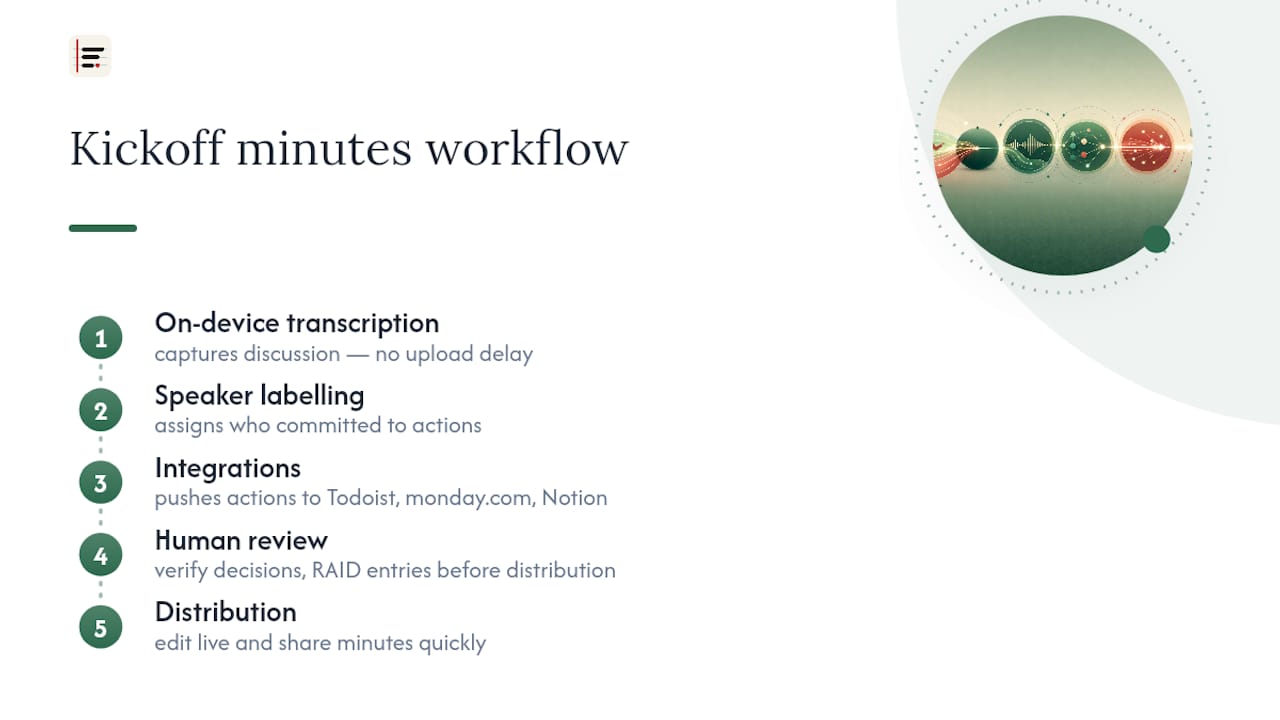
Trust transcription for capturing what was said. Don't trust it blindly for what was decided, particularly on anything with financial or contractual weight. A quick human pass over the decision log and RAID entries before distribution still catches the ambiguous phrasing that automated capture can misread.
Pro Tip: Run transcription during the meeting and edit live rather than after. Correcting an owner name or a due date while the context is fresh takes seconds; doing it the next day means rereading half the transcript to find it.
What actually prevents kickoff failures
Most failed kickoffs have the same root cause: someone treated the meeting as a presentation instead of a working session. Every agenda item should end with either a recorded decision or an assigned action. If it ends with neither, the item wasn't finished.
Have the sponsor speak early. The order of the agenda shapes how the team reads every commitment that follows, and a sponsor who opens with genuine investment sets a different tone than one who appears for five minutes at the end. Record what's explicitly out of scope, with a date attached, because dated negative-scope decisions resolve more disputes than anything else in the document. Close on one owner per action, one deadline each, and the first checkpoint already on the calendar before anyone leaves the room.
— James
Turn kickoff minutes into tracked work automatically
Minuted gets your kickoff minutes out the door faster than manual note-taking, because the transcript and the labelled actions exist the moment the meeting ends, not an hour later when someone's finished typing up scribbled notes. Recording happens on-device, so audio never leaves your machine, which matters when a kickoff covers commercially sensitive scope or budget detail.
A typical workflow looks like this: record the kickoff, get a transcript with speakers labelled, then push the action items straight into Todoist, monday.com, or Notion with owners and due dates already attached. For teams handling in-person sessions, the same capture approach applies to face-to-face kickoffs as it does to video calls.
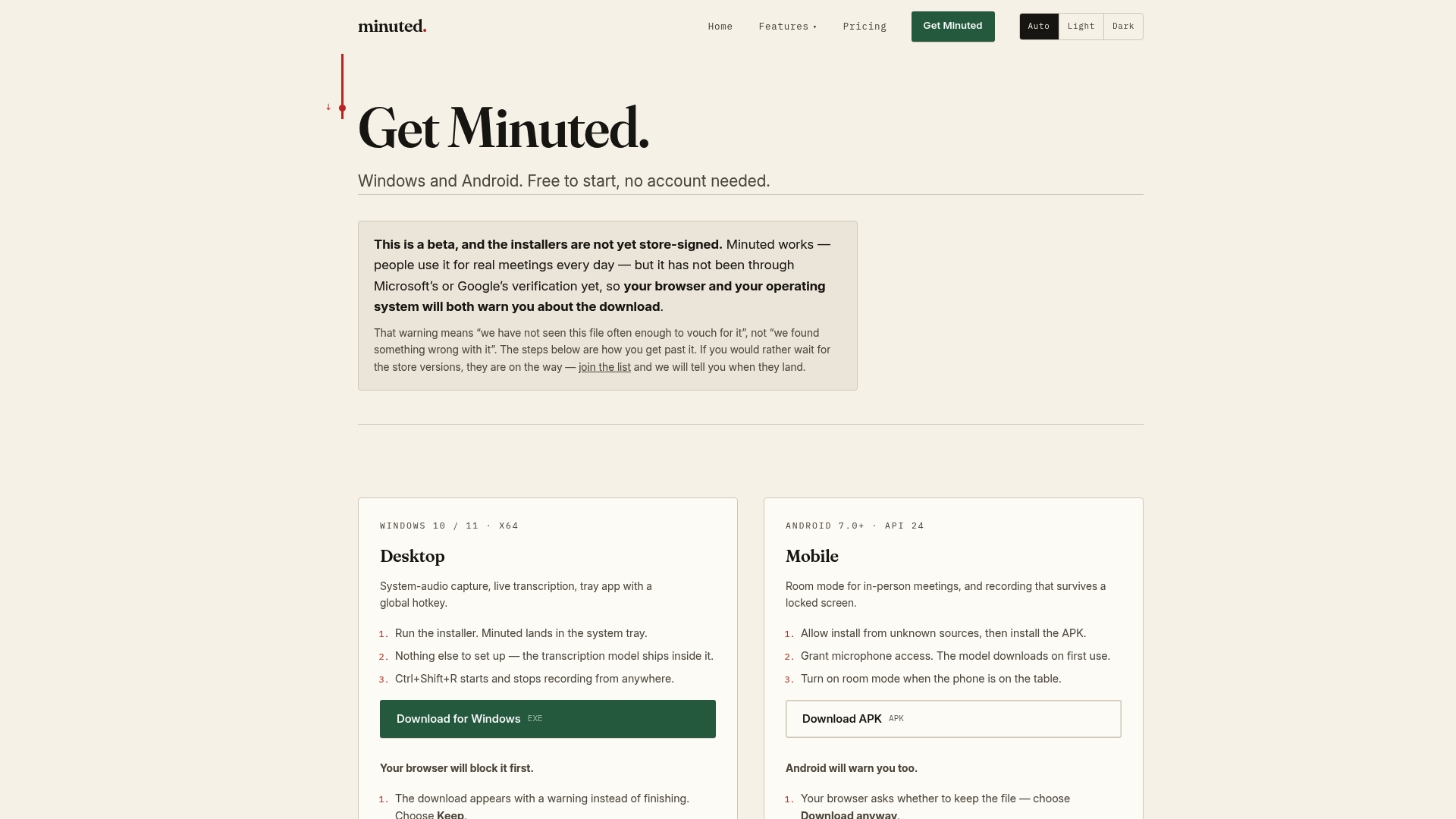
If you want to see exactly what stays on your device before you commit to anything, check how Minuted compares to other notetakers on privacy. Otherwise, start with the free local mode and add cloud minutes or integrations once you know it fits your kickoff routine, download Minuted and try it on your next project launch.
Sources
- Project kickoff meeting: agenda, checklist, and template
- How to run effective project kickoff meetings that drive results
- Kickoff meeting agenda, template, and project checklist | Portfolio Hub
- Kickoff meeting template: agenda, roles and next steps
FAQ
How long should a project kickoff meeting be?
Most moderate projects need 60 to 90 minutes. Scale down to around 45 minutes for small, simple projects, and allow up to two hours for complex, multi-team or vendor-inclusive kickoffs.
What does "project kickoff" mean?
A project kickoff is the first formal meeting where a team aligns on goals, scope, roles, timelines and working agreements before delivery work begins. It marks the point where the project charter moves from planning into active execution.
What are some good ideas for a kickoff meeting?
Have the sponsor speak first to signal genuine commitment, time-box each agenda item so risk discussion doesn't get cut, and treat every item as a working decision rather than a status update. Closing with a booked checkpoint and assigned owners turns talk into tracked work immediately.
What should be included in a project kickoff agenda?
A repeatable agenda covers project purpose, meeting roles, timeline and milestones, admin tasks, and immediate next steps, sent to attendees at least 48 hours in advance. Build in dedicated time for risks and open questions rather than treating them as an afterthought.
How quickly should kickoff minutes be shared after the meeting?
Distribute minutes within 24 hours of the meeting ending and give attendees 48 hours to flag corrections before treating the document as final. Tools that produce a labelled transcript during the meeting make same-day distribution realistic rather than aspirational.