
Treat confidentiality as a bounded, auditable choice: the chair must state limits, who may attend, and recording rules before confidential items are discussed. Confidentiality is not a blanket status but a deliberate control over who may know what, and why. The sections below set out the legal reasoning, concrete examples, a defensible protocol, and how to respond if something goes wrong.
TL;DR:
- Confidentiality rules must be defined before discussions, specifying limits, attendees, and recording policies to ensure they are deliberate and auditable.
- Only classify and restrict access to confidential items based on criteria like identifiability, harm, and necessity, with legal or safeguarding duties overriding confidentiality.
- Recordings, transcripts, and chats pose risks as they can persist and leak unless secured, with local processing and strict retention controls reducing exposure.
- In case of a breach, quickly contain, assess, notify if required, and update controls, with documented risk assessments protecting organizations legally.
- Using on-device transcription tools minimizes leaks by avoiding external servers, and clear, justified confidentiality labels build trust and reliability in sensitive meetings.
Table of Contents
- Why confidentiality matters for professional meetings and governance
- What counts as confidential: five categories and borderline cases
- A defensible meeting protocol for attendees, minutes and retention
- Recording, transcription and chat: the risks people miss
- If a breach occurs: a short incident workflow
- A ready-to-use opening statement and meeting checklist
- How on-device transcription lowers confidentiality risk
- Why narrowly justified confidentiality preserves trust
- A privacy-first option for teams handling sensitive discussions
- Sources
- FAQ
Why confidentiality matters for professional meetings and governance
Frank discussion depends on participants trusting that sensitive material will not travel further than agreed. Once that trust breaks down, contributions become guarded and decisions get made with less information on the table.
Several practical drivers make confidentiality a governance matter rather than a courtesy:
- Data-protection duties require organisations to limit access to personal information to those who need it for a specific purpose.
- Legal privilege can be lost if legal advice discussed in a meeting is shared with people outside the privileged relationship.
- Safeguarding obligations often override confidentiality entirely, since a disclosure duty can take precedence over a promise of privacy.
Governance guidance generally favours a presumption of openness, reserving confidential sessions for items that genuinely need them and recording the reasons for that decision.
What counts as confidential: five categories and borderline cases
Most confidential items in professional meetings fall into a small number of recognisable categories. Knowing which one applies helps you decide how tightly to restrict access, and for how long.
- Personal or safeguarding information: details that could identify an individual or expose them to harm if shared.
- Personnel and disciplinary matters: performance issues, grievances or investigations involving named staff.
- Privileged legal advice: guidance from a lawyer that loses its protection once shared outside the privileged relationship.
- Sensitive financial or commercial negotiations: figures, terms or positions that could prejudice a deal if leaked.
- Strategy or planning that could prejudice outcomes: information that would disadvantage the organisation if known early.
The Australian Bureau of Statistics frames confidentiality as preventing identification, direct or indirect, and restricting access to those with a genuine need to know. That framing gives a workable test for borderline cases: could someone be identified from this, would disclosure cause harm, and is restriction actually necessary for this purpose. Public bodies should also check whether a statutory disclosure duty overrides any confidentiality decision, since freedom-of-information and safeguarding law can compel release regardless of what was agreed in the room.
A defensible meeting protocol for attendees, minutes and retention
A confidentiality decision only holds up under scrutiny if it was made deliberately and can be explained afterwards. That means classifying the item, restricting the room, and controlling what happens to the paperwork once the meeting ends.
- Classify the confidential purpose and the authorised audience before the item is discussed, not after.
- Restrict attendance to those who need the information for their role, and note who was excluded and why.
- Instruct the minute-taker to omit unnecessary identifying detail and to mark any redacted version clearly.
- Record the rationale for the confidential classification alongside the minutes, so the decision is auditable later.
- Distribute documents only through approved platforms, never by personal email or unmanaged chat tools.
- Set a retention schedule for drafts, recordings and transcripts, with a defined point for secure deletion.
Pro tip: Agree the retention period before the meeting starts, not when someone asks for the recording six months later.
Recording, transcription and chat: the risks people miss
Recordings, transcripts, and chat logs are often the weakest link in an otherwise careful confidentiality plan, because they persist long after the discussion itself is forgotten.
- Give a short pre-recording notice stating the purpose, storage location, retention period, and who can access the recording, in line with guidance such as the ELFT audio-visual recording policy, which advises deleting recordings once minutes are approved.
- Use organisationally approved devices and platforms for confidential recordings, and avoid personal phones or unmanaged apps.
- Treat transcripts and automated summaries as records in their own right, subject to the same access and deletion rules as the recording itself.
- If a covert or unauthorised recording is discovered, stop the meeting, note who made it and why, and take legal advice before deciding on next steps.
The HCPC's guidance on confidentiality makes a point worth repeating here: accessing confidential information without permission can itself be a breach, even if nothing is later shared onward.
If a breach occurs: a short incident workflow
A suspected breach needs a fast, consistent response rather than an improvised one. The sequence below works across sectors because it separates containment from judgement.
- Contain: secure the affected files, restrict access to any recordings or transcripts involved, and preserve evidence rather than deleting anything.
- Assess: identify what data types were exposed, who could be affected, and the likely harm, and write this down as a short risk assessment.
- Notify: follow sectoral rules on when notification is required, health and public-body settings often have their own thresholds, and record the reasoning behind any decision to notify or not.
- Remediate: update access controls, minute-taking rules or retention settings so the same exposure cannot recur.
Pro tip: Write the risk assessment before deciding whether to notify anyone. A documented "no notification needed" decision protects you far better than an undocumented one.
A ready-to-use opening statement and meeting checklist
Setting expectations out loud at the start of a meeting removes ambiguity later. A short script covering scope, attribution and recording policy takes under a minute to read and gives every attendee the same understanding.
A workable opening might run: "This item is confidential to those present. We are operating under the Chatham House Rule, so you may use the information but not attribute it to any speaker. This meeting is not being recorded unless stated otherwise. If anything discussed triggers a legal or safeguarding disclosure duty, that duty takes precedence over this agreement."
- Confirm the attendee list matches who is authorised to be there.
- Confirm whether an approved recording device is in use, and who controls it.
- Name the minute-taker and agree the redaction approach in advance.
- Set the retention period and a date to review the confidentiality classification.
| Checklist item | Decision recorded at meeting |
|---|---|
| Attendee list confirmed | Yes or no |
| Recording device and owner | Named or none |
| Minute-taker and redaction approach | Named person, agreed method |
| Retention period | Fixed date or trigger event |
| Review date for classification | Fixed date |
How on-device transcription lowers confidentiality risk
Recordings and transcripts are exactly the kind of "meeting trail" that undermines confidentiality decisions made in the room, since a leaked audio file or an unsecured transcript can undo every other precaution. On-device processing addresses this directly by keeping audio and raw transcripts off networked servers unless a user explicitly chooses otherwise, which narrows the number of places sensitive material can leak from.
When evaluating any transcription tool for confidential meetings, look for:
- Speaker labelling, so minutes reflect who said what without extra manual work.
- Calendar and task integrations that do not require sending recordings to third-party servers by default.
- Secure local storage with explicit, adjustable retention controls rather than indefinite cloud retention.
Procurement teams should ask suppliers directly: where does the audio go, how long is it kept, who can access it, and is there an audit log. Minuted's approach to this is set out on its data flow page, which explains what stays on the device and what, if anything, leaves it.
Why narrowly justified confidentiality preserves trust

Confidentiality used too freely stops meaning anything. When every item is marked sensitive by default, colleagues stop trusting that the label reflects real risk, and the practice starts to look like avoidance rather than protection.
The stronger habit is to require a documented reason every time confidentiality is invoked, and to revisit that classification after the meeting rather than leaving it standing indefinitely. Publishing a non-sensitive summary of what was discussed, where possible, does more for trust than a blanket confidentiality notice ever will.
— James
A privacy-first option for teams handling sensitive discussions
Teams that regularly discuss confidential material often want the benefits of automated transcription without adding another place for that material to leak. Minuted processes audio and generates structured minutes on-device, so recordings and write-ups can stay off external servers unless a user chooses cloud processing for extra features.
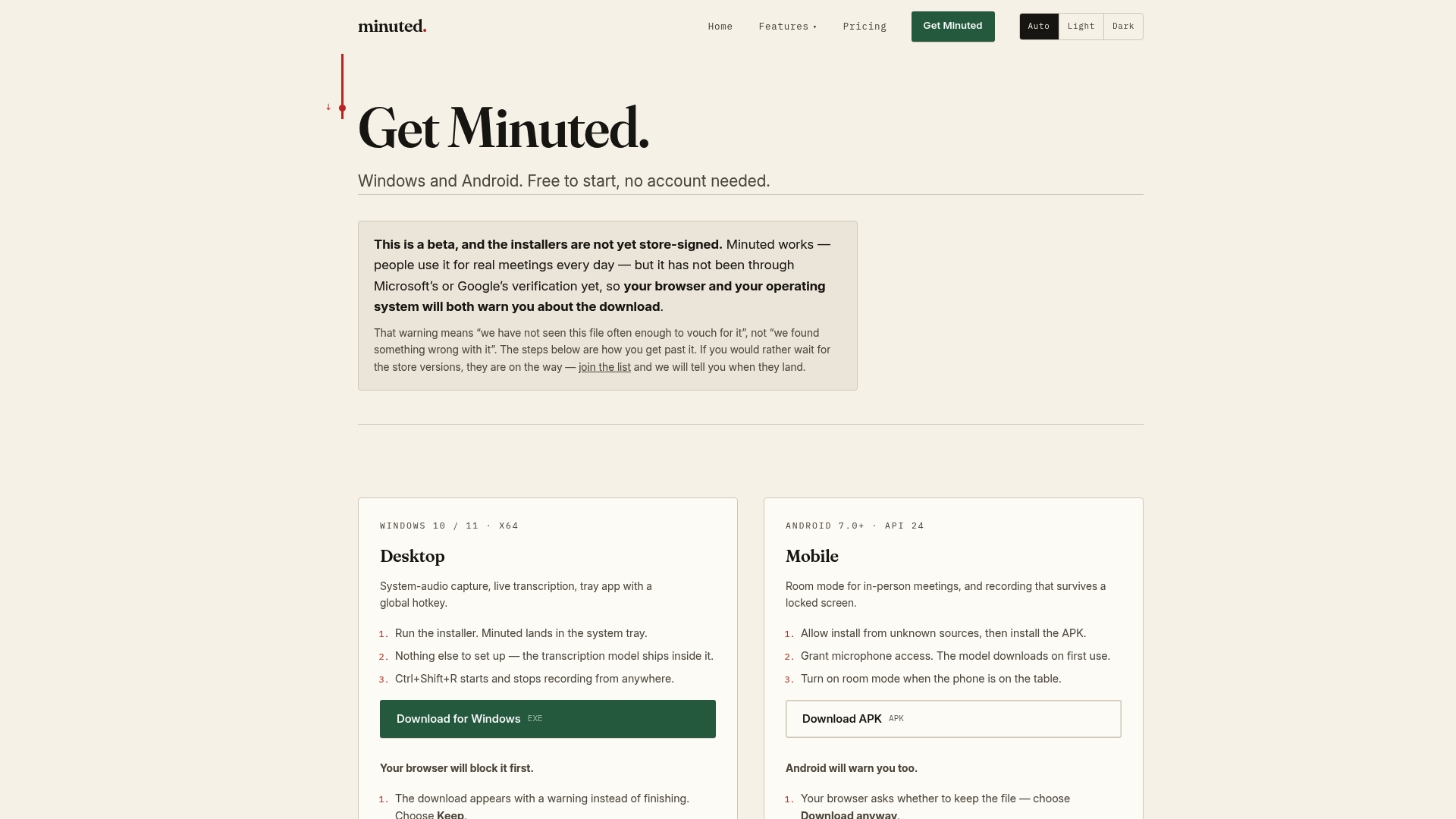
It labels speakers, integrates with calendar and task tools, and works offline, which matters for meetings held in rooms without a stable network connection, covered in more detail on the in-person meeting notes page. For teams that want to see the plans available, Minuted's pricing page lists the Free, Pro and Ultimate tiers, with Pro starting at £10 per month and Ultimate at £20 per month, both also available as annual plans. You can review the full breakdown and start a trial from there.
Sources
Adapt one policy template to your sector and jurisdiction rather than combining several, so the rules stay consistent across meetings.
- Chatham House Rule
- Australian Bureau of Statistics — confidentiality definition
- HCPC guidance on confidentiality
- ELFT audio-visual recording policy
This article is general information, not a substitute for advice from a qualified lawyer. Consult a qualified legal professional about your own circumstances before acting on anything here.
FAQ
What are the five C's of confidentiality?
There is no single agreed "five C's" framework in the sources reviewed here, and definitions vary by sector. A more reliable approach is the need-to-know test set out by the Australian Bureau of Statistics: identifiability, harm and necessity.
What is the rule of 7 in meetings?
This is not a confidentiality standard covered by the sources referenced in this article. If you have encountered it in a specific organisational policy, check that policy directly rather than assuming a universal rule.
What are five examples of confidential information in meetings?
Common categories include personal or safeguarding information, personnel and disciplinary matters, privileged legal advice, sensitive financial or commercial negotiations, and strategic planning that could prejudice outcomes if disclosed early. Each should be classified and restricted according to a need-to-know basis, as set out in the ABS confidentiality definition.
What is classed as a breach of confidentiality?
A breach includes sharing confidential information with someone not authorised to receive it, but it also includes accessing confidential information without permission, even if nothing is shared onward afterwards, according to HCPC guidance. Both onward disclosure and unauthorised access should be treated as reportable incidents.