
A board meeting transcript is a working record used to draft audit‑defensible minutes, not a substitute for approved minutes. The immediate action for secretaries is straightforward: capture the recording securely, use the transcript to verify motion language and contested statements, then archive both with a documented chain of custody and a retention policy that maps to your governance obligations.
TL;DR:
- Transcripts serve operational purposes like verifying motion language and contested statements but should only be attached to the archive if required by policy.
- Retention policies must comply with legal frameworks such as Sarbanes‑Oxley, and transcripts involving MNPI or EU personal data require careful security and lawful processing measures.
- Using transcripts enhances accuracy, searchability, and accountability, but risks include unauthorized distribution, accidental leaks, and AI participation vulnerabilities.
- Effective secretarial workflows involve pre-meeting checks, real-time diarisation, and post-meeting reviews to prevent errors and ensure proper archiving.
- Selecting a transcription vendor depends on security, retention control, diarisation accuracy, audit logs, and compliance with standards like SOC 2, not just feature lists.
Table of Contents
- Minutes versus transcripts: roles and uses
- Legal and regulatory considerations for board records
- When transcription helps, and when it introduces risk
- Board secretary workflow: before, during and after the meeting
- Security, retention and audit‑defensible practices
- How to choose a compliant transcription approach or supplier
- How Minuted's privacy-first features address governance needs
- A secretary's practical checklist
- A privacy-forward option worth evaluating
- Sources
Minutes versus transcripts: roles and uses
Formal minutes record decisions, motions and the outcome of votes. They are the legal record the board approves and relies on in an audit or dispute. A transcript captures something different: verbatim speech, hesitation, tone and exact timing, none of which belongs in a clean minute but all of which can settle an argument about what was actually said.
Secretaries use transcripts operationally rather than as final documents.
- Pull exact motion wording when the draft minutes need precision before adoption.
- Verify a contested statement when a director disputes what was recorded in the summary.
- Check timing against timestamps when sequencing of votes or amendments matters later.
Attach a transcript to the permanent archive only when board policy calls for it, usually alongside sensitive votes or contested proceedings.
Legal and regulatory considerations for board records
Retention obligations vary by framework, and mapping policy to the correct law matters more than most secretaries assume. Under frameworks such as the Sarbanes‑Oxley Act, organisations must preserve audit-related records for defined periods, and board documentation increasingly sits inside that same governance and reporting discipline, a trend reflected in recent annual meeting and reporting season commentary.
Two areas need particular caution:
- MNPI and executive sessions. Material non‑public information discussed in camera needs handling separate from the general record, often with counsel involved in deciding whether a transcript is created at all.
- Discovery exposure. Transcripts and raw audio can become discoverable in litigation or regulatory review, which is why organisations must decide in advance, not after a subpoena arrives, what gets kept and for how long.
Statistic in context: governance advisers increasingly frame transcription as a security-first procurement decision rather than a convenience feature, expecting enterprise-grade controls built into the tool from the outset. Where meetings involve personal data of EU residents, the GDPR's rules on audio recording also apply, requiring a lawful basis and clear notice before recording begins.
When transcription helps, and when it introduces risk
Transcription earns its place in governance work when it improves accuracy without expanding exposure. Used well, it delivers real benefits.
- Precise motion and vote language, reducing disputes over what was actually approved.
- Searchable records that let secretaries locate a decision from months earlier in seconds.
- Traceable action items, so accountability doesn't depend on someone's memory of who agreed to what.
- Accessibility for directors who missed a session and need the substance, not just a summary.
The risk side is real too. Unauthorised distribution of a transcript containing MNPI, accidental leakage through a cloud tool with broad retention, and automated note-taking bots quietly joining calls all create exposures that governance teams underestimate. Legal commentary on AI participation in board meetings specifically warns against letting active AI bots into high‑stakes sessions without security review.
Pro Tip: Default to on-device or restricted-cloud processing for any session touching MNPI, and put a line in the meeting notice stating that a recording will be made, why, and who will have access to it.
Board secretary workflow: before, during and after the meeting
An audit‑defensible transcript starts with preparation, not with pressing record.
Before the meeting:
- Check governance policy on recording and confirm consent or notice requirements are satisfied.
- Test microphones and seating so every voice is captured cleanly, since transcription accuracy depends heavily on audio quality and disciplined turn-taking, as practitioner guidance on board meeting transcription confirms.
- Load attendee names and specialist vocabulary into the transcription tool ahead of time to improve speaker labelling.
- Capture metadata: date, meeting type, quorum, and who is authorised to access the recording.
During the meeting:
- Keep one person responsible for recording control, including pausing for executive sessions.
- Spot-check diarisation early so misattributed speech gets flagged, not discovered after adjournment.
- Timestamp motions and votes as they happen rather than reconstructing them later.
- Route executive session audio to a separate, more restricted file from the outset.
After the meeting:
- Review the transcript against the recording and correct obvious misattributions or mishearings.
- Extract verbatim motion text for the draft minutes.
- Circulate draft minutes for approval, keeping the transcript as a reference document, not the record itself.
- Archive audio and transcript together with immutable logs showing who accessed and processed each file.
Security, retention and audit‑defensible practices
Technical controls separate a governance-appropriate tool from a convenience app. At minimum, expect AES‑256 encryption at rest, TLS 1.2 or higher in transit, role-based access control, and multi-factor authentication on any account that can reach board recordings.
Operational proof matters as much as the technology itself.
- A current SOC 2 Type II report, not just a claim of compliance.
- A disclosed list of sub-processors, so you know exactly who else might touch the data.
- Contractually guaranteed deletion timelines and signed NDAs covering anyone with access.
Statistic in context: procurement teams researching transcription vendors increasingly treat SOC 2 documentation as a baseline requirement rather than a bonus, which shifts the buying conversation from features to evidence. Chain-of-custody records, showing who captured, processed, reviewed and archived each file, materially strengthen a board's position if a record is ever challenged in litigation or regulatory review. Configurable retention, set to match your board's own policy rather than a vendor default, closes the loop.
How to choose a compliant transcription approach or supplier
Selection should run through a fixed checklist rather than a feature comparison, because governance risk hides in the gaps between features.
- Security posture: encryption standards, access controls, and whether audio ever leaves the device.
- Retention options: can you set deletion timelines that match board policy, not just vendor defaults?
- Diarisation accuracy: does the tool reliably separate speakers in a room with six or more voices?
- Audit logs: is there an immutable record of who accessed or edited a transcript?
- Integrations: does it fit existing calendar and task workflows without creating a second system to maintain?
When talking to vendors or your own IT team, ask directly for SOC reports, data residency details, model training policy (does audio train external models?), and written deletion guarantees. Codify the answers into board rules covering who may record, where files are stored, and what approval step precedes archiving.
Pro Tip: Ask every vendor the same single question first: "If audio never needs to reach your servers, does it have to?" The answer tells you more about their architecture than any brochure.
How Minuted's privacy-first features address governance needs
Minuted processes audio on-device in real time, which keeps raw recordings off third-party servers unless a board explicitly opts into cloud processing. For sessions touching MNPI or executive matters, that distinction is the difference between a controlled record and an unnecessary exposure point.
- Speaker labelling helps secretaries attribute motions and statements correctly during review, cutting down on post-meeting correction time.
- Calendar and task integrations connect the transcript to action items without a manual re-entry step.
- Local processing suits confidential sessions; cloud write-up options remain available when a board's retention or collaboration needs call for them.
Choosing between local and cloud processing should follow the same logic as any other governance decision: match the tool's mode to the sensitivity of the meeting, not the other way round.
A secretary's practical checklist
Three habits separate a defensible record from a liability. First, never let a transcript stand in for adopted minutes, however accurate it reads. Second, always separate executive session audio from the general recording, no exceptions. Third, document the chain of custody as you go, not after someone asks for it.
The most common mistake is treating transcription as a convenience feature rather than a governance decision, which is how sensitive audio ends up on a platform nobody vetted.
— James
A privacy-forward option worth evaluating
Minuted offers real-time transcription that runs on-device, with no audio required to leave the room unless cloud processing is selected. Speaker labelling and calendar or task integrations reduce manual clean-up after sessions, without requiring trust in a server.
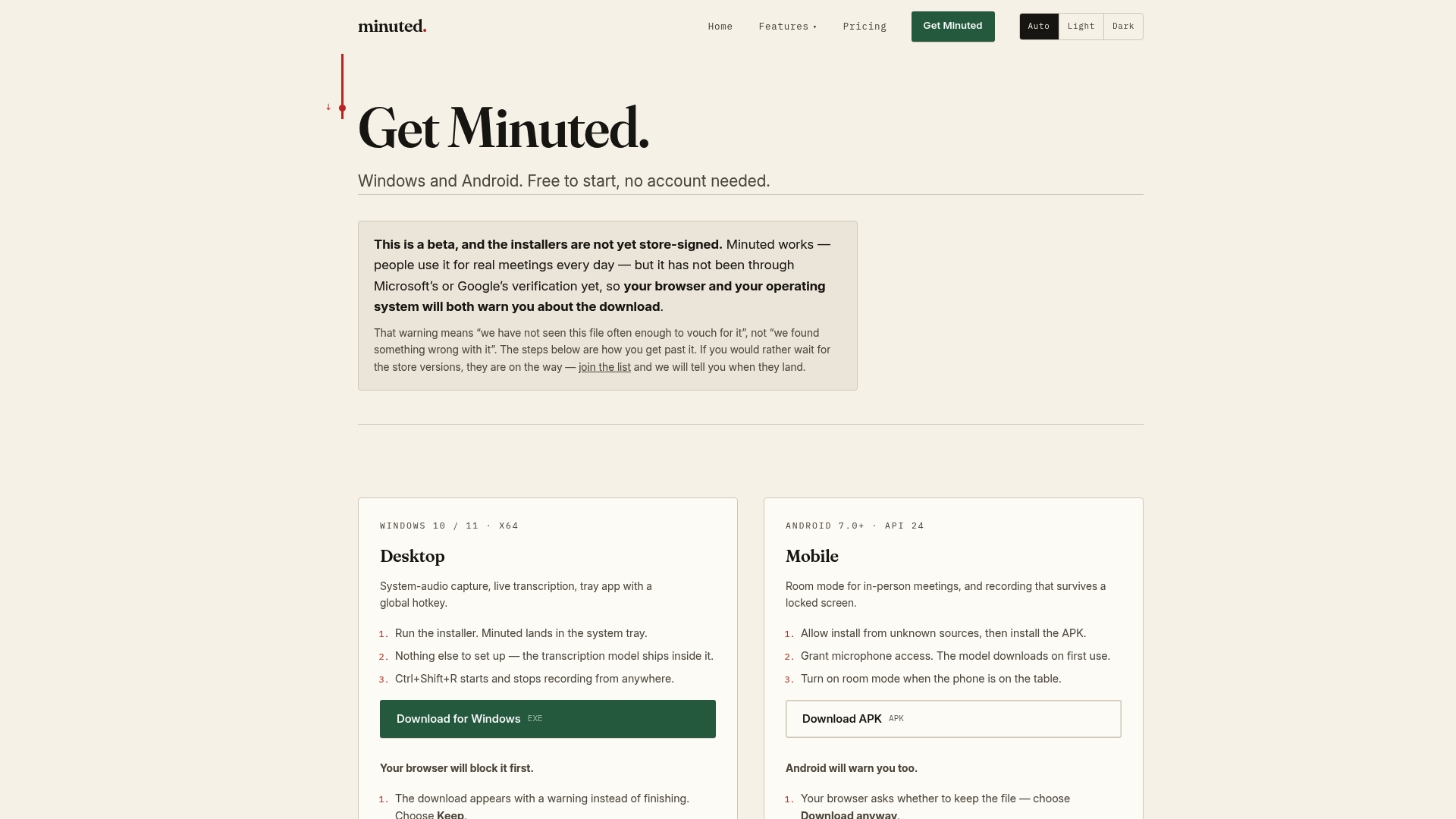
If confidentiality, retention control and audit-defensible records matter for your board, weigh Minuted against your own checklist rather than a generic feature list. Compare exactly what leaves your device versus other note-taking tools, review the full feature set for integrations and speaker labelling, or head straight to the Minuted product page to see how in-person capture works before your next board session.